
[Forbes]. Airplane billboard's top gun 'targets excitement'
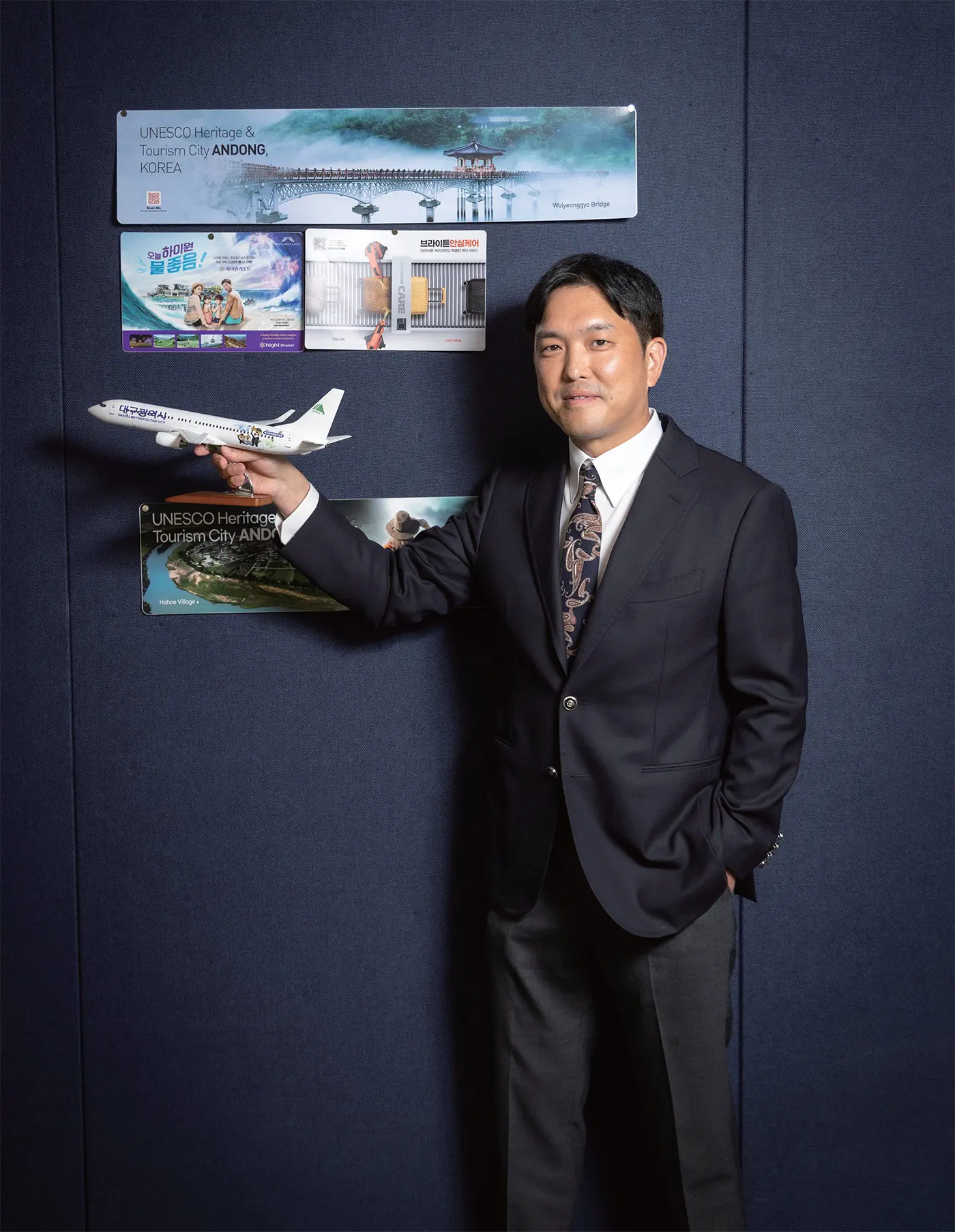
With the post-pandemic surge in travelers, airplanes are emerging as new media. Advertising images wrapped on the inside and outside of the airplane fuselage capture the excitement of travelers. QR codes are being utilized and viralized to non-passengers on social media, leading to online and offline marketing.
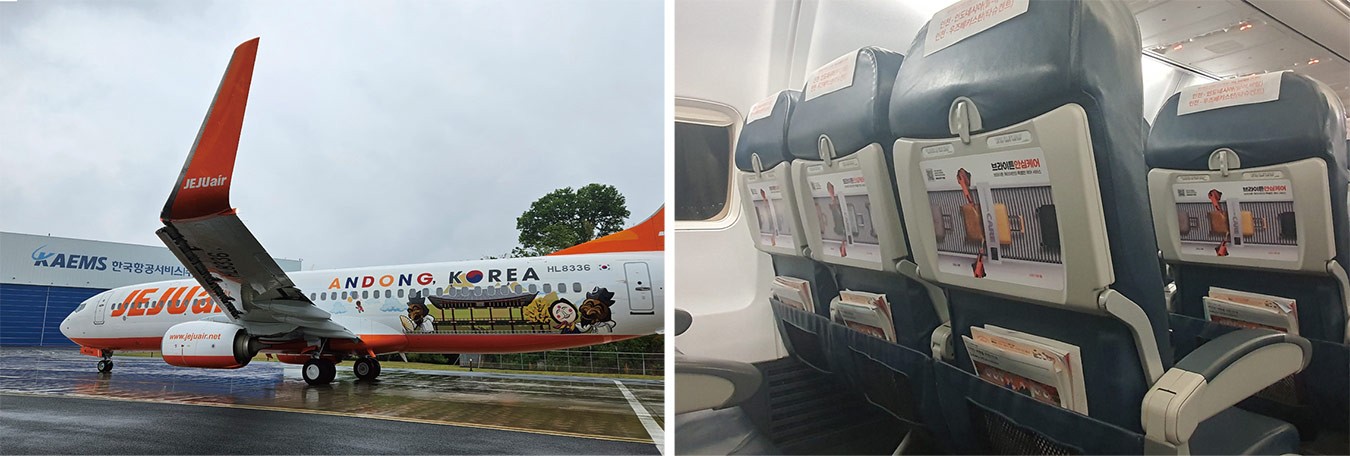
The city of Andong, Gyeongbuk, has a unique promotional strategy. Since 2022, it has wrapped images of major tourist destinations on the inside and outside of the fuselage of three airplanes to expose them to domestic and foreign visitors. This year, the images include Hahoe Village, Dosan Seowon, Byeongsan Seowon, Nakgang Mulgil Park, Wolyeong Bridge, Chehwa Jeong, and Seonseong Susang-gil. In particular, the exterior wrapper is designed with the words ANDONG, KOREA, and 安東 韓國, along with the Mandalu of Byeongsan Seowon Temple and Andong's traditional mask. The aircraft travels between Yantai, Qingdao, and Weihai in Shandong Province, China, as well as Japan and Southeast Asian countries. The graphic advertisement also features a service that provides more detailed destination information by scanning a QR code before takeoff and during the waiting time after landing.
The results are in the numbers. According to monthly reports by aircraft and route, the direct exposure to passengers on board was 683,000 over eight months, and the indirect exposure to waiting passengers at domestic and international airports was 2.3 million. The QR code in the advertisement also shows how many people visited Andong City Hall's promotional page, which had a click-through rate of 2.51 TP3T, which is incomparable to the average access rate of 0.11 TP3T for local governments on the portal. The publicity effect is also great outside of the passengers. It was estimated that the unusual aircraft advertising content went viral on Andong City and the airline's SNS, reaching more than 300,000 people. Last year, 46 media outlets reported on the campaign, making it an issue.
EMCG is an offline integrated marketing company that has been utilizing the new media of aircraft. Based on the only aircraft graphic media in Korea, we provide public relations marketing strategies to local governments, government offices, and various brands. Aircraft graphic media is analyzed to have high recognition rate and brand recall rate because the MZ generation has a high proportion of boarding and can be exposed for more than 3-4 hours on average. In addition to the online exposure effect through QR marketing, the advantage is that it can create a public relations synergy effect in addition to passengers through spontaneous SNS viral effects. This is why Daegu Metropolitan City has been promoting Daegu-Gyeongbuk Integrated New Airport and Gangneung City has been advertising on aircraft wraps to promote its excellent tourist destinations.
Mr. Meng started EMCG in 2017 after working in marketing at Samsung SDS, SK Marketing & Company, and SK Planet. "Outdoor advertising clients are most curious about how many times their ads have been seen and whether impressions are linked to sales," said Meng, who we met in late August. "Aircraft graphic media has overcome the shortcomings of traditional outdoor advertising because it can aggregate accurate data and connect online. This is why it is gaining traction as a new advertising medium in the post-pandemic era."
3 to 4 hours of fixed exposure to high spend Gen MZ
Travel spending has exploded recently. According to the Aviation Information Portal System, both domestic and international traveler demand has returned to pre-COVID levels this year. In August, the number of domestic passengers reached 10.72 million, an increase of 14.11 TP3T year-on-year. This was driven by a 19.61 TP3T increase in international passengers to 7.96 million, reaching the level of 97.81 TP3T in August 2019 (8.14 million) before the outbreak. The number of international flights also increased to 45,831, nearly catching up with the 47,052 flights in 2019. With international passenger traffic hovering around the 7 million mark every month since May, airlines have been busy expanding their skyways.
"As the number of air travelers has exploded to 10 million per month, regardless of peak or off-season, the number of promotional marketing activities by brands targeting them is also increasing," said Meng. "Not only brands that provide travel-related products and services, but also existing outdoor advertisers are interested in utilizing various TPOs (Time, Place, Occasion) such as traveling to and staying at the airport, waiting time during takeoff and landing, etc." Recently, the Korean outdoor advertising market has been undergoing major changes due to the development of new technologies and deregulation. According to the Korea Local Government Finance Corporation, the outdoor advertising market is expected to reach 4.28 trillion won this year.
Mr. Meng pointed out that aircraft graphic media is characterized by four main features: Generation MZ, optimal TPO, IMC system, and offline to online. First of all, the MZ generation, which is the most favored by advertisers, is the main target. Currently, EMCG is wrapping advertisements on the airplanes of six LCCs (low-cost carriers) in Korea, including Jeju Air, where 701 TP3T of the passengers are Generation MZ and 201 TP3T are Generation X. "In particular, 601 TP3T are female passengers, which is the most favored buying group for advertisers," says Meng. Optimal TPOs that target the "excited mind" are also a competitive advantage. It's a completely different experience in terms of likability and motivation than commuting on a bus or subway, and the "lock in" effect of being exposed to an ad for three to four hours on a flight is significant. Inside the aircraft, various contents can be realized as graphic advertisements by utilizing tray tables (seats), side wall panels (walls), and window media (windows).
Diverse IMC schemes are also an advantage. "We can use flight attendants to conduct various event marketing, such as product sampling and distribution of promotional materials and coupons, and announce them on the in-flight announcements to enhance the promotional effect," says Meng. "For Japanese routes, we can also sample Korean face masks and link them to duty-free and paid sales on board." The inclusion of QR codes on advertisements is a strategy that capitalizes on the 40+ minutes of online contact opportunities before takeoff and after landing. By inducing access through mobile phones, it was possible to provide detailed information and integrated online and offline marketing. In particular, LCCs do not have individual monitors, so there is a lot of attention to the tray table.
"Traveling on an airplane is an exhilarating moment, and travelers are open to unique content," said Meng. "If we can take advantage of this situation to promote marketing that fits their TPOs, the effect will be enhanced, and we can link it online to create a structure that leads to sales."
EMCG's leadership in the aircraft wrap advertising market is the result of years of market research and technology. In particular, it has the sole business license for in-flight wrap advertising for domestic airlines. "Advertising materials attached to aircraft are considered aircraft parts and must meet the FAA's weight and balance standards for each type of aircraft, each advertising material, and each attachment area, and pass various safety tests, such as preventing toxic gases in case of fire," said Meng. "We have secured the exclusive rights to the Korean market from Global Onboard Partners, the holder of the FAA, and have secured the technology." Some Korean airlines have also tried to enter the graphic media business, but have given up due to technical barriers, he said.
Personalize book-to-ride with vertical media
EMCG's goal is to create a promotional marketing solution that covers the entire travel process, from planning the trip, to traveling to the airport, to staying at the airport and boarding. To achieve this, we are segmenting the air travel process and creating customized vertical media.
During the travel planning and booking phase, we will provide targeted marketing for each of the three main channels: OTAs, home shopping, and airline apps. In the airport travel phase, we show banner ads in limousines and airport railways, and gender- and age-specific pop-up ads when tagging T-money. Upon arrival at the airport and before boarding, we have a location and payment-based targeting system, including airport displays and cart ads, location-based customer targeting for telecom companies, and airport duty-free shops for card companies. Finally, during the boarding phase, wraparound ads are displayed on the inside and outside of the aircraft fuselage, and promotions are carried out using the cabin crew.
To this end, EMCG is actively utilizing another business pillar, vertical media. EMCG utilizes the media of Korea's three major telecommunications companies, major membership providers, and card companies to conduct marketing based on the exact number of members of each media who have consented to receive advertisements. In particular, it offers a program that precisely targets only prospective customers who are likely to purchase its products and services, which is considered an alternative to the recent 'cookie-less' issue.
"We have found that the brand imprinting and motivation effect is much higher when the promotional marketing is customized step by step," said Meng. "Even small and medium-sized enterprises with limited budgets can take advantage of aircraft graphic media by using export vouchers." Companies that advertise on airport buses and brands displayed at Incheon International Airport are the primary customers, he said.
View original article: https://www.forbeskorea.co.kr/news/articleView.html?idxno=340426